
A cleaning company may have useful experience scattered across invoices, inspection logs and a manager’s memory. Organizing that evidence before an opportunity arrives can make a future response clearer and easier to support.
For negotiated acquisitions under FAR Part 15, past-performance evaluation considers relevance, recency, source and context. The rules contemplate similar federal, state, local and private contracts. That does not mean every procurement uses the same evaluation method: read the actual solicitation. FAR 15.305(a)(2).
1. Make one record for each project
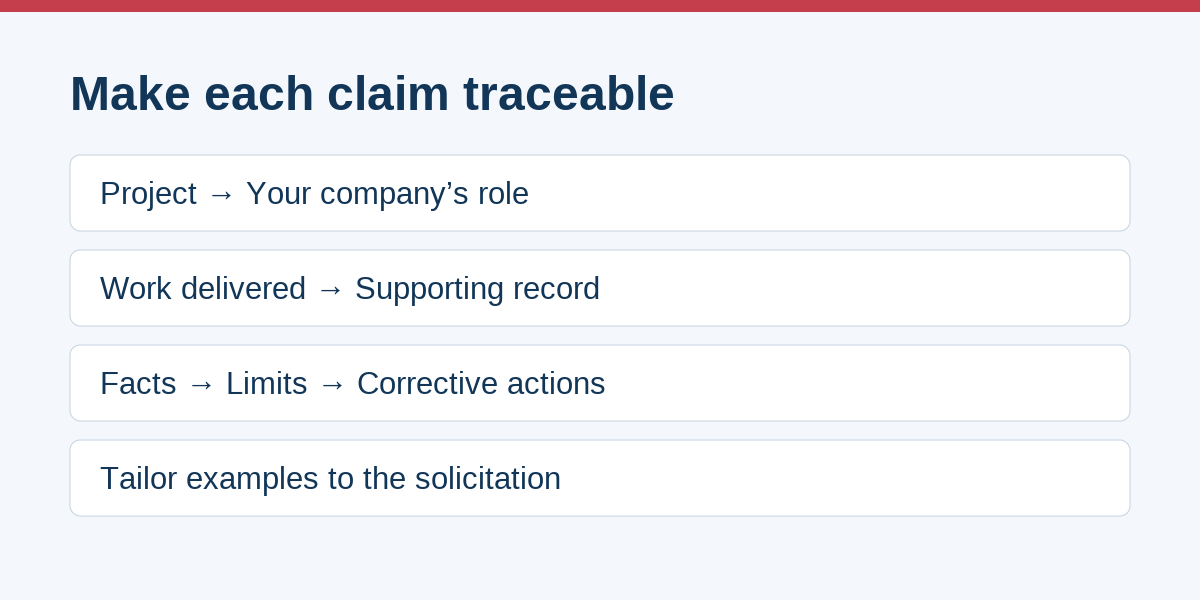
Start with the customer, work dates, service location, tasks and your company’s role. Separate work performed as the prime contractor from work performed as a subcontractor. Do not present an employee’s earlier experience as a contract your business completed.
2. Describe the work concretely
Record what you actually delivered: building types, service frequency, staffing responsibilities or equipment used. Include quantities only when you can support them. Explain why an example resembles the new requirement instead of calling every project “highly relevant.”
3. Keep evidence beside each claim
Link each result to an appropriate record, such as an inspection report, approved work log or customer feedback. Distinguish an invoice from proof that the customer accepted the work. Store confidential records securely; do not publish client information simply because it helps tell the story.
4. Describe problems honestly
Record significant issues, corrective actions and what happened afterward. A short factual account is more credible than a claim that nothing ever went wrong.
5. Tailor the submission
Your working file is an internal preparation tool, not a standard federal form. Follow the solicitation’s requested project count, time window, format and reference requirements. Confirm reference details and permission before sharing them.
Try one useful internal measure: project examples with supporting records ÷ project examples in your file. This is an organizing aid, not a government scoring standard.
Explore Gov Network plans · Your business reviews and submits its own bids.